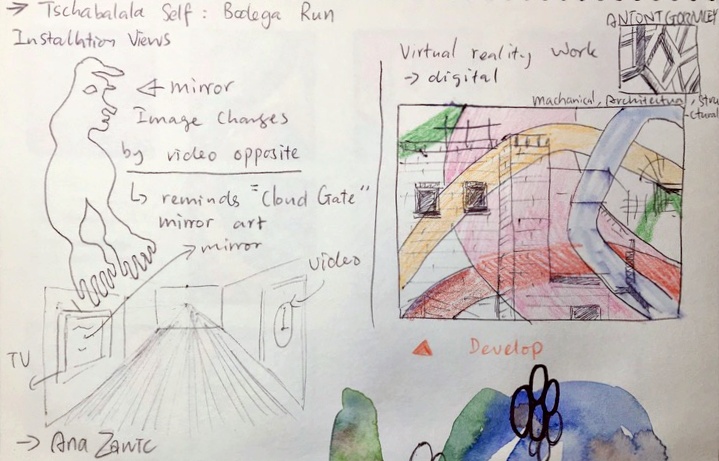
This blog would be a digital sketchbook for team 2, showing various artists, photographers, or textiles artists' work. I will talk about how did their work inspired me and how did I apply the ideas to my work. Some ideas came from imagination, the sketchbook shows the process I used artists' inspirations as starting points and how I combined my own ideas using these features.
I have a great passion to dig a topic which I interested in, therefore, I will keep exploring the theme of 'Elbow; Human Portrait' from term one. Also, a fresh new topic coming into my studio work, 'Patterns'. I love Kusama's patterns and installation and found making patterns is something I really enjoy doing. Then I decided to do it as much as I can that see if I can make my patterns more personal. To have a very unique, strong personal style, like Kusama, I experimented with different artists' patterns and tried the ways how they build up to them. In this process, I learned drawing and painting techniques, also build a foundation to be a professional artist: thinking about the size of works, how to install them, etc.
Artists' work and photographs of sketchbook pages are showing. This term I made more digital work, however, most of my ideas were written on practical papers, my notebook, and sketchbook. So, I organized them and added them to this blog.
1. Hassan Hajjaj
Lynette Yiadom-Boakye, 2017/1438 (Gregorian/Hijri)
Metallic Lambda on 3mm Dibond in a Poplar Wood Sprayed-White Frame with Red Tomato Squeezies
55 1/2 × 40 1/2 × 4 1/2 in
141 × 102.9 × 11.4 cm
Hassan Hajjaj is a contemporary photographer, designer. He has a strong style that he repeats patterns and adds around the edges of the frame of his works. He uses strong contrasting colours in the background designs, which also shows the customs of models. His patterns nearly show anywhere. Then, I added patterns to two items in my room and a picture of a car that took by myself on the street. Here are the drawings.
Digital work 1, Body Lotion, 2021, own work
I installed an image I selected from my room to iPad Pro, then I drew patterns digitally on top of the photo. I might try a different brush last time or change the setting of the oil paint. It is a bit transparent that the colours are too thin. They barely covered the background image. Ink pens might be more efficient to cover, they offer solid textures.
Digital work 2, Hair Candy, 2021, own work
In a similar process, this time I tried to change the opacity of the original image. Therefore, the oil paints show stronger coverage in this painting.
Digital work 3, Reimaged Hair Candy, 2021, own work
A reimagined piece of work 2; I just let the background patterns of work 1 show up; It is because the patterns are in a different layer, so some part of the candy pot still showing.
I love making marks and patterns; the last term I used oil paints on cardboard papers. And keep adding oil to some parts of my drawing. Therefore, the oil painting shows a different level of thickness; the texture and pattern of the cardboard are lovely, which show up in the part with less oil paint. In this case, I did not use cardboard as a tool or a canvas, it is a part of my drawing. So in the 'Hair Candy', I changed the opacity of oil paint, it shows streaks on the cover of this candy bottle.
Digital work 4, Car, 2021, own work
Apart from items in the room, I tried to add patterns on objects outside. For example, a car installed on street. I took picture of it and add drawings afterword digitally. The idea is transferring 2D drawings to 3D objects. It is a remote term, I feel it is nice to work on the computer.
I made this drawing with two white edges of the top and the button, which I want to make like a photo from an instant camera. It does not show well in this blog, that it disappears in a white background. I quite like the outer shape of this car, it looks like it is from the 60s. To make it more 60s, I perhaps can add a yellow or B & W filter. The idea is also from an article from The Guardian, which shows artists were making artwork on streets; such as murals and graffiti. For this reason, I also took pictures of glass, floor outdoor; try to participate in the artists' activities, but remotely.
own photograph, 2021
own photograph, 2021
These are images I took on the street. There is a drawing on this abandoned glass. Although it is not a masterpiece, it likely links to the idea of artwork on street.
Photographed by my friend, Jessica, 2021
This picture shows a mosaic on a street. I think it gives a direction that I make my art pieces outdoor. I will try this idea next term.
2. Jeff Nishinaka
Jeff Nishinaka, Untitled, paper sculpture, n.d.
Jeff Nishinaka makes incredible paper sculpture; he layering the papercuts and creates 3-dimensional effects, similar to clay relief. The last term I used air drying clay to make a clay relief of my elbow; I also used the paper cutting technique and found it very interesting that I layered a piece of black paper on top of a white sheet. The contract showing the negative and positive drawing. Then, I would like to develop more into this area in term 2. The shadow created naturally in NIshinaka's work, to create a similar effect, I would like to use cardboard and sponge tapes; this type of tape is thick, and it may works.
After trying the ideas out, I found the tape is not thick enough to give gaps between each paper. To solve this problem, I add small pieces of cardboard between the two tapes. It kinda likes the feature in Nishinaka's paper cut. I think it is a good try and will continue to use this technique in future creations. In this term I will focus more on drawing, either digital and practical.
I will develop this idea further, some paper sculptures are not easy to make. I am thinking if can get some help at Uni. For instance, tools or machines to help me work efficiently. Another artist called Hazel Glass makes the very careful paper cut and layers them up to be 3D sculptures. A screenshot here. The website shows very beautiful paperwork. I really like the texture of the paper, however, I don't know how to start. I made one based on my understanding and it took me a long time, maybe there are methods to work faster. I decide to do more readings or watch videos of how artists create paper cuts as a reference.
Girl & Koi, paper cut, black sugar paper, 2021, own work
The 'Girl and gold fish' made in 2019, the girl is one of my best friends. The size is approximately an A4 size, hard black card paper. Another two I made the last term were a life drawing of a woman and a dog in kimono.
Woman portrait, untitled, paper cut, back sugar paper and white print paper, 2021, own work (Left)
Dog in Kimono, untitled, paper cut, white print paper on black sugar paper, 2021, own work (Right)
I feel more comfortable with thicker lines, these two look simple but all lines work well that they are clear to see. This idea might cooperate with inspirations from Keith Haring's drawing; with very thick black outlines. Examples will show below No.16.
3. Jadé Fadojutimi
Jadé Fadojutimi, Ob-sess(h)-ion, 2020. 180 x 170 cm, oil, acrylic and oil stick on canvas. Image courtesy the artist and Pippy Houldsworth Gallery, London © Jadé Fadojutimi, 2020. Photo: Mark Blower

At the beginning of term 2, I had a painting workshop, 'Building world in paints'. Jadé Fadojutimi her work are very touching. Even though I don't understand what she wants to show to audiences, I feel her work are very emotional. They are very colourful, in the meantime, they show loneliness. She expore herself to the public, her work is the inside world. I like the way how she works; in the interview video, she said she does not plan on the sketchbook, she draws directly on the canvas. Her paintings are changeable and incredible. I can see her working process in her paintings; she keeps taking off and adding paints, by following her mind. It is a good reference that the artist shows paintings do not need to be completed as neat as possible. I think it is important to show feelings and emotions to the public. Sometimes I focus too much on painting skill that it might be a barrier to show or create what I want; it makes it more difficult to make work I feel satisfied and comfortable with. In the beginning, 'emotions' is one of my ideas, I grouped the initial research using Mila note. After I drew some sketches, I decided to focus on patterns that I more interested in.
4. Frank Auerbach
Frank Auerbach Self-portrait 1958
© Frank Auerbach
Courtesy Daniel Katz Gallery, London and Marlborough Fine Art
Frank Auerbach was in my research file in the last term. I like how the blur in this portrait; Auerbach blended the colour together, but I can still see the tone clearly. It creates the structure and volume for this man. The colour tone creates an atmosphere, sadness, horror? I Will step further in term 3; I will look into more details about techniques, drawing skills. For example, how the artist shows movement using paints.
I tried to make this effect using soft pastels. Some sketches on paper, show below.
Those two are not what I expected. I think more layers of colours are needed, to make a thicker surface. To make an effect like Auerbach's portrait, I might use need to add more layers of soft pastel, or used something else, like acrylic or oil paints. I will do more experiments in the next term.
5. Christian Marclay
48 War Movies 2019, Single-channel video installation, colour and stereo sound, Continuous loop, Dimensions variable
The Clock, 2010. Single-channel video, duration: 24 hours.
Christian Marclay created this image by repeating pictures and layered them together. It is a photoshop's work, I made one on my own using his work as an inspiration. 'The Clock', nearly a mime, without and words saying in the video. The gallery places sofas in a room and viewers can sit and enjoy the film with their partners. I have been there with one of my friends, we were sitting there for about 30 minutes. I did not quite understand what the artist wants to deliver, however, it was enjoyable to be in there. The whole environment and atmosphere make people feel comfortable, and willing to stay. I think installation is very interesting, it changes the viewers' mind. How to install your work is important. Therefore, I work out ideas for installation while creating some art pieces.
The video work is not available to share on this blog, so I will put it in my PowerPoint. To reflect my videos, the biggest problem was the backgrounds. Even I can use a bigger piece of paper or a bed sheet to create backgrounds for my film work, it is still difficult to work on my own. It will show better quality if I work in a studio will proper photography equipment, such as a tripod. Sometimes I need to take some actions and also hold the camera, which makes my videos blurry. Besides, I should have a better consideration of the background. For instance, 'The Microwave looks much better and more professional than others, like 'Sounds of Rice'. It is because I set it in a dark background, viewers' eyes only focus on what I want them to see, a bowl of milk and two bread inside. However, in 'The Sounds of Rice', I didn't set a good background, it shows too many information, such as ground, table, some clothes at the back. It confuses the audiences and makes this work looks random.
I will continue to make some film work next term. To develop and explore my idea of 'The Elbow', deep look into the mechanic of a human's body and movement. I would like to use a clock in a film to show the metaphor for my elbow. It would be in B & W, also planned as a mime.
6. Jennifer Packer
Tia, 2017 Oil on canvas 99 x 63.5 cm 39 x 25 inches Collection of Joel Wachs Photo: Matt Grubb
I mentioned that I love patterns. Also, I like drawing a human portrait. Jennifer Packer's painting perfectly matches my thoughts. I made a similar composition on my drawing, using a ball pen and acrylic water marbling.
Woman portrait, ball pen drawing on acrylic water marbling, paper, 2021, own work
7. David Deweerdt
Untitled, David Deweerdt, c 2020-2021
The water-flow like the texture of the brush storks interest me. I don't know how to make something like this, maybe it is drawn on a surface that does not absorb water, such as a plastic plate I used in the last term. Therefore, I made a water marbling. The image shown above, combined this idea with Jennifer Packer's portrait.
8. Antony Gormley
Antony Gormley has the biggest influence on my work. The Covid limited me to make some big in studios, also it is very difficult to make sculptures in the size like Antony Gormley's work. He is supported by a team and also has Financial assistance. That's the reason why he can assess different materials and make various forms of 3D work. I might say, in my case, I can create sculptures digitally or use perspective to make my model looks big. Then, I make some drawing on my iPad and show my idea from his work. My sketch shows below and a more completed piece followed.

Sculpture across a window frame, digital drawing, reimaged 'Elbow', 2021, own work
My idea was to make an outdoor sculpture and people see views through it. The concept is like Gormley's work. However, the work is a development from my 'Elbow' 3D work. I want to stretch it to a bigger size. Considering it is across the window, the metal may be too heavy, a paper might work better. This idea link to the photographer, Tom Lovelace.
'Elbow', sculpture, digital drawing, 2020, own work
9. Hieronymus Bosh
Totals vision, oil painting, 1490-1500
A reference for one of my ideas, 'Dream diaries'. I decided to focus on pattern making, so I will look back later.
10. Hilma af Klint
Fine wool, 79 X 19, dry clean only
Hilma Af Klint's patterns are bold, colourful and abstract. I like her colour combinations and geometric, physical shapes. It looks very similar to my sketchy idea, I am planning to make something like her work. My patterns could be decorative to print on objects, such as clothes, scarfs, even dining tables.
11. Christina Quarles
Casually Cruel, oil painting, 2018
Again, Casually Cruel's painting has a strong style. The human bodies in her painting in between real and unreal art. It is easy to identify there are three figures in this image, however, their faces, arms, and legs are weird. For example, the one in the middle, it's feet looks flat. Then skin tone is grey, and a bit unusual colour, such as fresh orange. Very rare, there are some white curves on it. It looks like a slide of salmon and the skin peeled off by someone and shows bones.
12. Clet Abraham
28 APR, 2020, Description: hey guys, courage, you just have 39678754 pieces left to stick
Clet Abraham, his work shows a totally different direction. His drawings and installations are very interesting. I always expecting what is his next idea. Based on the original traffic logo, he can create a world; little men and animals are interacting in this circle. Very creative and inspirative artist.
Some sketches on my sketchbook.
13.
Moshe Safdie
Habitat 67 designed by architect Moshe Safdie. This building reminds me of Gormley's drawing. It shows the beauty of mechanic and structure. Paper boxes are very common to see in life, rather than using them for my 'Elbow' project, I might focus on itself, to create a building model.
14. Luc Tuymans
Untitled, digital oil painting, 2021, own work
Luc Tuymans's piece is a very good reference to learn drawing with tones. It was a good practice that I understand light and shadow better. I like the way how he chooses what to focus on. He looks at the human figure as a whole, less detail but more on lights and darkness. It is a little bit like Frank Auerbach's portrait above. Although it looks very easy to draw that there are not many details, thus, I spent some time and can not really get the effect like his portrait. I think one of the reasons is I used a small brush. In this case, a bigger brush might help.
15. Blek Le Rat
Bleck Le Rat usually makes B & W stencils, and colourful graffiti. The graffiti is always in a black line. That makes me think I can combine this idea with Haring's drawing. I drew some graffiti-like patterns with thick outlines. Also, I combined it with my initial idea, 'mosaic'. Then, it became some little drawings and join together.
First I tried to make a small sample of stencilling.
Mosaic patterns, markers and fine-liners, 2021, own work
16. Keith Haring
Keith Haring and Clet Abraham are having similar style, that both of them are very contemporary, illustrative, and simple. Different from Abraham, he creates drawings on blank papers. Normally thick black lines and the main character, a little man. The digital drawings from the beginning were also inspired by Haring's ceramic sculpture. Compare to mine, I more like his pottery. It shows the composition of contemporary and ancient art. The pot reminds me of Egyptian ceramics, replacing Haring's patterns.
A sketchbook piece that drew in his style.
17. Jean-Michel Basquiat
Sketchy and free, also looks like a children's painting. I tried to follow his drawing method. I created a drawing on a sketchbook (using acrylic) first and transferred it into digital. The work is a video and it is not available to show on the blog. I will add it to my PowerPoint.
Reimaged of Basquiat's painting, 2021, own work
18. Tom Lovelace
Tom Lovelace is a photographer. He photographed himself with geometric shapes. It gives inspiration to my idea that I might take some photos or sculptures, to transfer my idea to other forms of art.
One of my initial ideas is 'Shape of me'. Due to the covid lockdown, I have more time to glaze myself and being with myself. I want to show who I am in art. Then I sketched out my idea. It is a triangle in the centre of a sheet of A4 paper, some black random circles surrounded; they are chaos. The triangle is representing I am an introvert person, not easy to fit in a big environment. Also, a triangle is a strong shape that not like a square, rectangle, or other shapes. It is not easy to change. It shows my stubbornness, in the content. I am not easy to change my mind, that's why the triangle is in colours and the chaos outside is in entire black. Even though I am a triangle, it does not mean I am offensive; I have many different emotions, so the triangle is colourful. Primary colours are on each angle, sometimes I go extreme; those colours mix, combine in the middle. It means sometimes I am not extreme, quite inclusive.
Some more ideas and artists I marked on my sketchbook. I will add them to my PowerPoint instead.
I also created a page to exhibit my work on the Miro board as a group project. Here is the screenshot.
Reference list:
1. ART SY (2017)
Hassan Hajjaj. [online image] Available from
Hassan-hajj. [Accessed by 07/01/2021]
5. TATE (2021)
Who is Frank Auerbach? [online image] Available from
Auerbach-introduction. [Accessed by 16/01/2021]
6. WHITECUBE (2019)
Christian Marclay. [online image] Available from:
christian_marclay. [Accessed by 09/03/2021]
7. TATE (2010)
Christian Marclay born 1955. [online image] Available from
Christian-Marclay-6852. [Accessed by 09/03/2021]
8. SERPENTINE (2017)
JENNIFER PACKER: THE EYE IS NOT SATISFIED WITH SEEING. [online image] Available from
Jennifer-packer. [Accessed by 09/03/2021]
9. BANDITTOART (2021)
David Deweerdt. [online image] Available from
David. [Accessed by 20/01/2021]
14. CLET (2020)
28APRCLET. [online image] Available from:
clet-198. [Accessed by 01/03/2021]
15. ARCHDAILY (n.d.) AD Classics: Habitat 67 / Safdie Architects.
16. TATE (2014)
Luc Tuymans born 1958. [online image] Available from:
Luc-Huysmans-2612. [Accessed by 03/03/2021]
17. BLEKLARAT (2014)
Santiago de chile 2014. [online image] Available from
Cannes-2010. [Accessed by 01/03/2021]
18. THEKEITHHARINGFOUNDATION (2021)
The BluePrint Drawings Edition:33. [online image] Available from
art-work. [Accessed by 02/03/2021]